

;
contact_us
starsquaredpr-logo
×
Who We Are
more less
What We Do
more2 less2
Our Work Insights Careers Newsroom Contact Us
Team meeting

Why PR Is Important for Technology Companies

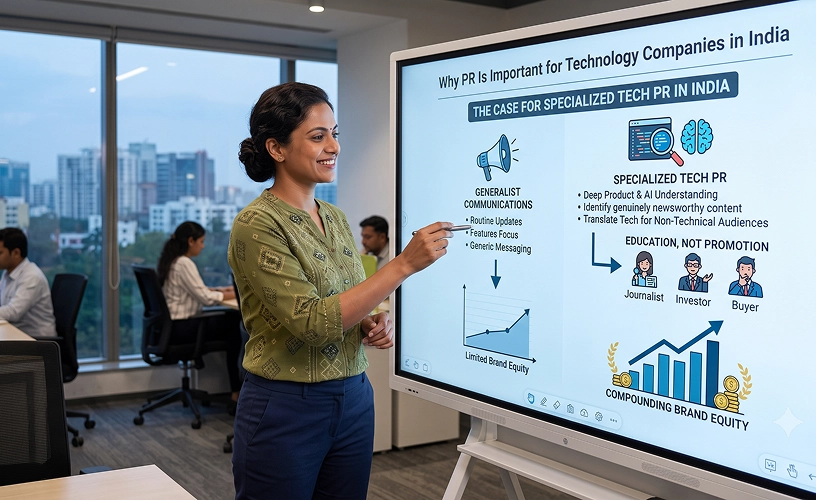
Technology companies sell complexity, whether that is an AI-driven cybersecurity platform, a machine learning powered observability tool, or an edge AI chip, and a journalist or analyst needs that complexity translated into a story that matters to their reader before they will cover it. That is why tech companies need specialised technology PR rather than a generalist communications team. PR for technology companies in India is about understanding the underlying product, including the AI inside it, well enough to identify what is genuinely newsworthy, separate from a routine feature update. Star Squared PR treats much of this work as education rather than promotion, breaking down what a piece of AI or deep tech actually does for a non-technical buyer, journalist or investor, and that kind of consistent, accurate education is what compounds into real brand equity over time, far more durably than a single product announcement ever could.

Measuring Technology PR Success

Evaluating PR success for a tech company boils down to a few measurable signals: coverage in the publications the target buyer or investor actually reads, share of voice against named competitors, and whether thought leadership placements translate into inbound interest from customers or analysts. This matters even more in AI, where hype travels faster than substance and a buyer's trust often depends on whether the coverage actually held up once people looked closer.

Top PR agencies for tech companies in India like Star Squared PR track these outcomes specifically rather than reporting raw clipping counts.

Team discussing growth

How Star Squared PR Supports Technology Companies

Our technology PR services support spanning numerous sectors and our day-to-day already involves translating AI capability into stories worth listening to.

Gain core tech PR strategies that require message simplification

Content strategy breaks down complex software architecture into relatable and impactful thought leadership narratives.

Making tech thought leadership interesting

We place executive commentary and bylines that establish a company’s leadership team as authorities on the technology trend they operate in, such as AI security, observability or edge computing. And we do it through storytelling.

Product and funding news cycles

Pitching launches, partnerships and funding rounds to the right mix of trade, business and mainstream technology press

Analyst and industry award positioning

Supporting clients as they pursue recognitions from bodies or industry awards, since third party recognition carries more weight with buyers than self-promotion. Businesses sometimes search for a partner whose work has helped clients earn this kind of outside recognition. We have a track record of consistently delivering on this aspect.

Crisis communication for technical incidents

Preparing clear, fast public statements for outages, security vulnerabilities or product issues before they escalate through an effective crisis communication strategy.

Talent and culture stories

Covering leadership hires, workplace certifications and culture milestones that support recruiting in a competitive tech talent market

Office discussion

Technology PR vs General PR

General PR works with established narrative formats: a product launch, a brand story, a corporate announcement. Technology PR requires something additional, the ability to understand what a technology actually does, why it matters to the specific audience that will use it and how to translate that into language a non-technical journalist or analyst can grasp quickly enough to write about it accurately. A generalist PR agency can produce a press release about a new product. A specialist technology PR agency can explain why that product's architecture is genuinely different from the competition in a way that passes a skeptical tech journalist's first follow-up question. 

The distinction matters because technology journalists are well-informed and quick to reject pitches that misrepresent or oversimplify a product. Star Squared PR's experience across cybersecurity, AI, edge computing, observability and semiconductor sectors means the team already understands the technical terrain before any client briefing begins.

Reaching the Right Audience Through Technology PR

Technology companies serve highly specific audiences: enterprise buyers, investors, developer communities, system integrators or a mix of all four, and each requires a different media approach. Reaching the right audience through technology PR starts with mapping who actually makes or influences the purchasing decision, then identifying the specific publications, platforms and analyst firms that audience trusts. For an enterprise cybersecurity company, that might be CISO-focused trade media and analyst reports from firms with enterprise security practices. For an edge AI company, it includes hardware-focused trade press and the engineering publications that product teams read. Star Squared PR builds audience-specific media maps for each technology client rather than sending a single press list to every outlet simultaneously.

Office discussion

Technology Sectors That Benefit Most From PR

While all technology companies benefit from strategic PR, the sectors where PR delivers the sharpest commercial return are those where trust and credibility directly influence a long, complex buying decision:

Cybersecurity

Buyers evaluate which vendor to trust with their most sensitive infrastructure, and independent media coverage and analyst recognition matter enormously in that evaluation

Artificial intelligence and machine learning

A sector where hype has outrun substance for years, making credible and specific media coverage a genuine differentiator for companies whose technology actually delivers

Enterprise AI and SaaS

Where the buying committee is large and the sales cycle is long, giving PR-driven brand familiarity significant influence over which vendors make the shortlist

Semiconductor and deep tech

Where the audience is small, highly technical and reads specialist trade media that a generalist PR agency typically does not have relationships with

Fintech and regtech

Where regulatory credibility and security positioning are as important as product features in a buyer's evaluation

FAQ's

Find answers to your most common questions about our Public Relations services, from media outreach to campaign strategies. Explore how we can help you elevate your brand with tailored PR solutions.

Technology companies earn consistent media coverage by giving journalists stories that are genuinely newsworthy to their specific readership rather than product announcements dressed up as news. The most reliable routes include executive thought leadership on sector trends, funding and partnership announcements pitched to the right mix of trade and business press, technical explainers that help journalists cover a complex topic accurately, and data or research findings that provide a new angle on a market the journalist already covers.
Trust in a technology context builds through a combination of third-party validation, consistent thought leadership and transparent communication. Analyst recognition, industry award placements, bylines in respected trade publications and a track record of accurate media coverage all contribute to the institutional credibility that enterprise customers and investors use to assess whether a technology company is worth backing.
The primary indicators are coverage in publications that the target buyer or investor actually reads, share of voice against named competitors in relevant trade media, whether thought leadership placements generate inbound analyst or customer interest, and whether media coverage is being referenced in sales and investor conversations. Star Squared PR tracks these signals against a baseline established at the start of each engagement and reviews them with clients monthly.
PR supports product launches by building a coverage strategy that lands the right message in front of the right audience at the moment of maximum momentum. This involves pre-briefing key journalists and analysts ahead of the public announcement, developing a tiered media list that prioritises publications most relevant to the target buyer, preparing technical explainers that help journalists cover the product accurately and planning post-launch thought leadership that sustains coverage beyond launch day.
When public trust in a technology category is declining, the companies that invest in specific, honest and technically accurate communication separate themselves from those making vague or inflated claims. PR helps technology companies build trust by placing specific, verifiable stories in credible publications rather than relying on marketing language that skeptical audiences discount. Star Squared PR's education-first approach to technology PR is designed specifically for this environment.
Building genuine thought leadership authority takes consistent effort over six to twelve months. The first placements establish a baseline presence; subsequent placements in progressively higher-profile outlets build the cumulative authority that makes a technology company the default reference point for journalists and analysts covering its category. Star Squared PR designs thought leadership programs with this compounding timeline in mind.