


Corporate Social Responsibility
Communicate credible social impact with CSR PR that centres evidence, community partners and long-term outcomes. Work with Star Squared PR.


Communicate credible social impact with CSR PR that centres evidence, community partners and long-term outcomes. Work with Star Squared PR.

Corporate social responsibility creates a programme. CSR PR helps people understand what that programme does, who it serves and how its results will be measured. The distinction matters because a worthwhile initiative can still be poorly understood if a company communicates only a donation amount or a launch-day photograph. Effective CSR communications give communities, employees, partners and stakeholders a clear account of the need, the work and the outcome. Done consistently, this can also contribute to a company’s corporate reputation by giving stakeholders a clearer view of its actions and commitments.
As a CSR communications agency, Star Squared PR has supported social impact communications for Educate Girls, a rural girls' education organisation that grew from its original villages in Rajasthan to work across tens of thousands of villages and reach more than a million girls. We have also supported a non-profit that runs eye-care and disability-awareness programmes across India. These assignments taught us that the strongest CSR stories begin with the community, the implementing partner and the evidence of progress, not the corporate logo.
We develop narratives, media programmes and content that connect an organisation's commitment with the work people can actually see. That can include partner announcements, leadership commentary, field stories and long-term progress reporting.


Impact claims need proof. Credible social impact communications depend on information that can be verified. We help clients identify the information that makes a story useful, such as the number of children who completed a learning programme, the locations served, the duration of support or an independently assessed outcome.
We also plan communications around meaningful moments: a new grant, an NGO partnership, an anniversary, recognition earned by the implementing organisation or a multi-year progress update. A single announcement rarely builds trust; consistent reporting does.
Section 135 of the Companies Act, 2013 applies to companies that meet any of the prescribed thresholds for net worth, turnover or net profit in a financial year. Qualifying companies must constitute a CSR committee in the circumstances set out in the law, formulate a CSR policy and spend at least 2% of their average net profits from the three immediately preceding financial years on eligible CSR activities, subject to the Act and rules. Communications does not replace governance, disclosures or implementation. It helps make approved, compliant work understandable to the audiences affected by it. For this reason, communications works best when it is planned as part of a company's wider CSR strategy in India from the start, rather than added after a programme has launched.

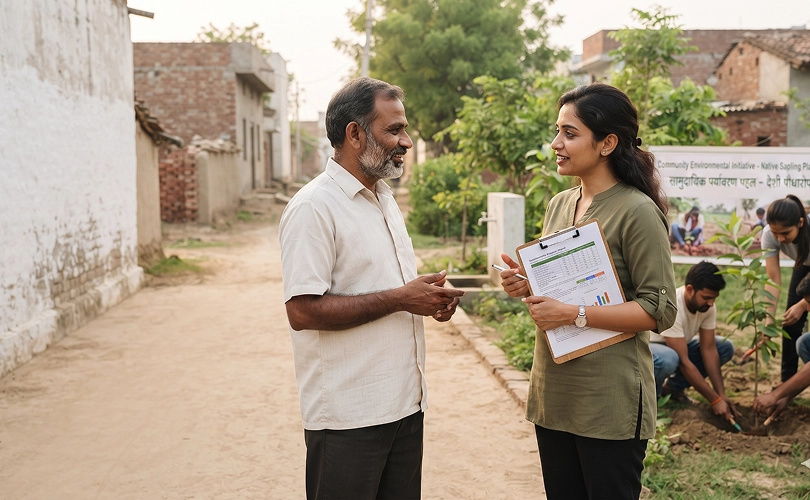
CSR communications focus on social programmes and the outcomes they support. ESG communications address a wider set of environmental, social and governance matters that investors, regulators, employees and other stakeholders may evaluate. A company may use both, but should not treat a CSR programme as proof of every ESG claim. Each statement needs evidence appropriate to its subject. For a broader look at communicating sustainability initiatives through PR, see our guidance on promoting sustainability efforts through PR.
The safest approach starts with specificity. Say what the programme does, who delivers it, what the company funds, what evidence exists and what remains unfinished. Avoid broad claims about changing lives or transforming communities when the available data supports a narrower statement. Credit implementation partners. Obtain informed permission before using personal stories or images. If a programme is new, describe it as new rather than implying established results.

Find answers to your most common questions about our Public Relations services, from media outreach to campaign strategies. Explore how we can help you elevate your brand with tailored PR solutions.