

From Tom Sawyer to AP x Swatch: Why the Best PR Makes People Beg to Participate
21 May 2026, Theja Ram


21 May 2026, Theja Ram


Mark Twain understood demand engineering long before anyone invented the term. In The Adventures of Tom Sawyer, young Tom is sentenced to whitewash a long fence on a Saturday morning. It’s an acute form of drudgery, and such a punishment that Tom has every reason to be miserable. Instead, he makes the job look so absorbing, enviable and quietly exclusive that his friends begin to beg for the privilege of painting it themselves. By the time Tom’s done, he convinces them to pay him for the right to do his homework.
Tom just manufactured desire by making something ordinary appear scarce, coveted and worth waiting for. The product hadn’t changed but the story around it had. That’s the oldest trick in the PR playbook and the best brands in the world have simply learnt to run it at scale.
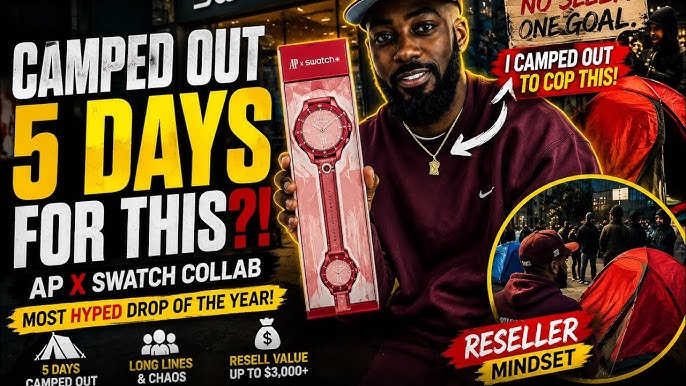
The most recent example is the AP X Swatch Royal Pop launch. It’s May 16, 2026 and Paris is doing something it hasn’t done since the last World Cup: forming enormous furious queues, where authorities had to deploy tear gas. In New York, police cordons off Manhattan Swatch boutique. In Singapore, the store sells its entire stock of 40 pieces in minutes and then closes its doors on hundreds of people who have camped outside for over 24 hours. In Mumbai and Bengaluru, security barricades buckle under the weight of the crowd. The product in question is a pocket watch. It costs hundreds of dollars and not a single person in any of these scenarios was forced to be there.
This was the Audemars Piguet x Swatch “Royal Pop” launch. And if your first instinct is to call it a crowd management failure, look again. Swatch had painted the fence. The world lined up to hold the brush and pay for painting it, metaphorically.
The Royal Pop launch did not arrive with a model, which Swatch had already proven years earlier with the Omega x Swatch MoonSwatch collection, and the mechanics were identical.
In March 2022, Swatch announced a collaboration that nobody had seen coming: a bioceramic chronograph inspired by the iconic Omega Speedmaster Moonwatch, priced at $260. The announcement broke the internet. Full-page advertisements ran across major publications with the lines “It’s time to change your Swatch” and “It’s time to change your Omega.” Nobody knew what they meant until two days before launch. Long queues formed outside Swatch boutiques across the world.
The watches were available only in physical stores, with no online option whatsoever. Customers could purchase no more than two. Demand collapsed supply within hours and secondary market prices soared to multiples of retail almost immediately.
And here is the number that matters: Omega Speedmaster sales reportedly rose by approximately 50% in the months that followed. The MoonSwatch made people want the real thing more. A $260 watch sold at $6,000 is classic halo effect built entirely through PR mechanics, not advertising spend.
Tom Sawyer would have recognised it immediately.
The same instinct has been reshaping India’s retail story, and Bengaluru keeps appearing at the heart of it. In February 2026, Nothing opened its first flagship store in India on 100 Feet Road in Indiranagar. CEO Carl Pei flew in personally for the opening. Thousands of people queued outside. The 5,000-square-foot space was built as a community platform: a content studio, gamified installations, a claw machine, complimentary refreshments, a hangout zone for meetups and product previews.
The store was the media, the CEO was the campaign. Nothing had ranked among the fastest-growing smartphone brands in India precisely because it understood that its audience did not want to be sold to. They wanted to belong to something.
Two months later, Off-White made its India debut at the Phoenix Mall of Asia, also in Bengaluru. The launch was not any other ribbon-cutting. It was a mall takeover with façade projections, barricades reimagined as brand theatre, digital screens running campaign content across the entire retail space. The co-founder said it plainly, “We wanted Off-White’s India debut to feel like a moment, not just a launch.”
Both brands treated the city as a cultural signal rather than a commercial checkbox. India’s style-conscious consumer is no longer waiting at the back of the global queue. Brands that understand this are winning sales and conversations.
Lay the AP X Swatch launches, the MoonSwatch, the Nothing opening, and the Off-White debut side by side, and the same five levers appear every time.
#1 Scarcity by design and no online sales. Deliberately sell only one or two units per customer with store-only availability. What most brands treat as a distribution problem, the smartest ones treat as a desire mechanism. The Birkin bag operates on exactly this principle. Hermès does not let a customer simply walk into a store and buy one. The customer must build a relationship with a sales associate first, wait and demonstrate commitment. By the time the bag is in the customer’s hands, they feel they’ve earned it, and that story is worth more than the bag itself. Swatch understood this instinctively. Removing the ‘add to cart’ button was a positioning decision.
When something is genuinely difficult to obtain, the act of obtaining it becomes part of the story. People are essentially buying the right to say they were there, much like Tom Sawyer’s friends offering him 12 marbles, piece of blue bottle-glass to look through, a spool, a key that wouldn’t unlock anything, a piece of chalk, a tin soldier, a fire-cracker
and a kitten with only one eye.
#2 The cultural collision that creates a new identity. AP is Swiss horological heritage, the kind of watchmaking that takes decades to master and costs as much as a car. Swatch is pop art and plastic. Off-White is luxury with a spray-paint aesthetic and its entire identity is built on the tension between the elevated and the accessible. When two worlds that should not meet actually do, both audiences show up at once, and neither can quite believe the other is in the room.
That tension is the story and the press covers it because the unlikely alliance headline writes itself. The Supreme X Louis Vuitton collaboration in 2017 proved the same thing. Streetwear’s most devoted buyers queued for hours alongside Louis Vuitton’s most loyal clients, and every fashion journalist on earth had to write about it. The collision creates a third cultural entity that neither brand could have produced alone, and that entity belongs entirely to the moment.
#3 Earned media wins over paid media every time. Every queue is a photograph because chaos clips mean more views. Every person who camped outside a store for six days is a piece of content the brand never had to commission, brief, or pay for because the crowd becomes the press release. Think about the economics of what Swatch achieved: the Royal Pop launch generated global news coverage across fashion, business, and mainstream media outlets without a single paid placement driving that conversation.
The chaos in Bengaluru, Mumbai, Paris, New York and Singapore was not the PR plan, but it was the PR result. This is what practitioners call the scarcity loop. Scarcity creates queues, queues create content, content creates demand for people who were not even in the queue, and that demand feeds the next launch. Once the loop is running, the brand’s job is not to shout louder. It is to stay out of the way and let the audience do the work.
#4 Jumping on the halo effect. The launch product is often not the point here but everything else around it is. Porsche understood this when it launched the Cayenne SUV in 2002. Purists hated it and said an SUV would dilute the brand, compromise the legacy, betray the spirit of the 911. Instead, the Cayenne made Porsche profitable enough to build a better 911. The MoonSwatch did something structurally similar for Omega: it introduced a new generation to the Speedmaster mythology at a price they could reach, then left them wanting the real thing. Nothing’s Bengaluru flagship did the same for its CMF sub-brand, lending the cheaper product line the credibility of a brand that had just opened a 5,000-square-foot experiential store with its CEO standing at the door. The flagship was a statement, which made everything else more desirable.
#5 There’s always a human face. The founder, the CEO, the person who stands for the brand and gives the press someone to photograph and a quote they actually want to run. In the case of the AP X Swatch launch, it was the crowd. In the case of Nothing, it was Carl Pei flying to Bengaluru for a store opening was a choice. He could have sent a regional director and a press release. Instead, he showed up, stood in the room, talked to customers, and became the story himself. That is worth more than any outdoor campaign, not because Carl Pei is famous, but because a founder’s presence signals genuine conviction. It tells the audience that the people who built this thing believe in it enough to be here. Journalists trust people more than press releases. And in a media environment where every launch looks the same, the human who actually cares is the most disruptive thing in the room. It is the lever most brands leave on the table, because engineering demand almost never arises in marketing or PR meetings.
Here is the honest footnote, because any serious conversation about the AP x Swatch launch has to include it. Stores shut across the UK, police used pepper spray on Long Island, thousands in Bengaluru and Mumbai left dejected. Swatch’s own Instagram account asked customers not to rush stores while simultaneously reminding them that the collection was not limited. The message was contradictory, the crowd management was inadequate, and the chaos that became earned media also became a liability.
The difference between a Nothing opening in Bengaluru and an AP x Swatch meltdown is not the scale of demand. Both brands generated enormous demand. The difference is planning, message discipline, and a PR team that has already written the scenario where things go wrong before they go wrong.
Demand without a plan is just a crowd. Demand with a plan is a brand moment people talk about for years.
The queue outside a store is an outcome arising from deliberate choices about scarcity, timing, cultural positioning, media seeding, and the stories that surround a product before anyone can buy it.
Tom Sawyer’s friends paying him was not luck. He read his audience, controlled the narrative, and made participation feel like privilege. The brands filling streets today are doing exactly the same thing, just with better production values and a great deal more tear gas. The brands that earn queues are not necessarily the ones with the best products. They are the ones with the best PR.
Behind every such success is a significant amount of work that the public never sees. Narrative architecture built months before a launch date; careful media seeding that creates anticipation without tipping into over-exposure; cultural intelligence that tells you whether Bengaluru or Mumbai carries the right signal for your brand’s India debut, and why getting that wrong costs more than the launch itself; influencer strategy that identifies the right ten people over the wrong hundred thousand; and scenario planning that has already written the story for the day the queue gets out of hand, the stock runs short, or a competitor tries to own your moment.
This is what a PR partner who understands demand actually does. It’s not always press releases and media lists. The work that makes a launch feel inevitable in hindsight, even though nothing about it was. Star Squared PR works with brands at exactly this intersection: where cultural ambition meets communication strategy, and where the difference between a moment that trends and one that endures comes down to how well the story was built before anyone showed up at the door.
If you are building something that deserves a line outside the door, let us talk about how to build it before opening day.